Music and songs are legally available in two major aspects:
a. Copyrighted
b. Public domain
(For readers looking for details on the following topics below, you can go directly to the related section):
License a song for film or video
Permission to record song
Licensing Music for your website
Music Licensing Matrix
License music – a demo page for asking permission to use music by applying for a music license online.
Naturally, if you use music or songs that belong to the public domain, then you will not need to get permission(read: When does music fall into the public domain?). However, things are very different if the music is copyrighted. Always remember that to ask permission to use copyrighted music is the same as asking for a music license to use them.
This is where a lot of confusion can take place. Bear in mind that the process would depend on the music copyright owner. Some copyright owners are not strict with their requirements in terms of asking permission. Typically, in most processes, you will be required to apply for a music license and pay some fee. While in some situations, it does not require you to apply for license or pay at all. This post would cover all these aspects in detail, so that you will know what to do regardless of any differences between the processes.
Step1.) Find the music publisher of the copyrighted music
You need to know the music publisher of the song. Music publisher administers copyrighted music. This is where you need to obtain permission to use music. In most cases, this is not available so you need to do some research. You can start with the artist or the songwriter of the song. You will know the artist or songwriter by examining the ID3 tags’ information of the MP3 file (or CD in-lay for CD album).
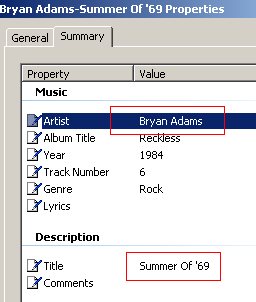
The ID3 tags information can be found by right-clicking the mp3 file then go to “Properties” – “Summary”. Other mp3 players such as an iPod provide this information much easily.
Once you know the artist, album and other information pertaining to the song; you can then perform a song copyright search to find out the music publisher of the song.
Another clue to find out where you have downloaded or obtained the song; if it is coming from a website, try to check what are the terms and conditions attached. Does it include information about the publisher? A good way is to contact the website owner representing the songs. Most of the time, website owner is not the music publisher but they know whom to contact if you are interested in using the songs.
Step2.)Describe how you will use the music to the publisher
To speed up the process ; you should be providing detailed information to the music publisher.
Once you have the contact information of the music publisher, provide them with the following information (they will be using the obtained information in issuing a license):
1.) Title and details of the project –if it’s a movie project, describe how the music would be used in your movie. Even though a lot of licensees often miss the details; some music publishers need to know what your project is all about. There are some sensitive topics that music publishers do not want their work to be included.
2.) Enumerate what music rights are you planning to use and why? – This is slightly complicated. A lot of licensee does not know these rights; below are some of the most common:
a.) Synchronization rights – if you want to use the song in your film, video or TV project. This would synchronize the song with the picture of the video/film/TV project. Even a slideshow with pictures exploit sync rights if you are planning to add copyrighted music to it.
Take note that there are different music rights for film that you need to know and needs to be cleared.
b.) Mechanical rights – if you want to use the song and have it included, sold/distributed in mechanical units such as CD, DVD, Blue ray, etc. If the music publisher is represented by the mechanical licensing agent such as Harry Fox agency.
Then you need to ask permission from them and not to the music publisher. Read this post to know more about what is a mechanical license agreement.
c.) Performance rights – some music publishers are also represented by performing right societies. These are ASCAP/BMI in the US or Filscap in the Philippines. You know this in your copyright search in the previous steps. For example, the song “Summer of 69” by Bryan Adams is published by Almo Music Corporation
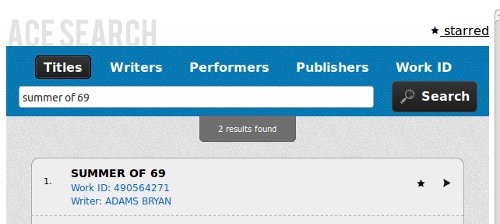
And this is an ASCAP publisher as shown below:
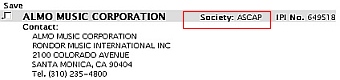
If they are represented, you need to ask permission to the society and not to the music publisher.
Performance right is a right to publicly perform the copyrighted music. This includes having them publicly shown on-air on TV (such as included in featured shows); or played on radio. This also includes performing the song on the public such as in the live venue/concert.
You can read this post to get more information about public performance music license.
d.) Master recording rights – the music publisher does not always own these rights. Some independent music publishers do. The owner of this is mostly the recording label of the artist. If the artist is self-produced or even self-published; then the artist itself is both the publisher and also own the sound recording/master recording.
As a background, this is the right to use the sound recording in your projects. One of the most commonly exploited music rights.
Case Example (more examples in the succeeding section): For a video producer wanting to use copyrighted music in his commercial video projects, the following rights are needed to be cleared:
a.) Sync rights- using the music along with the video content.
b.) Mechanical rights – putting the music in a video content and distributed as DVD, etc for sale.
c.) Master recording rights – using the master sound recording of the music.
Take note that the producer does not need to be cleared with performing rights because the producer won’t be showing the content publicly.

4 Responses
Hi Tim,
The simplest way you can do this is to attribute music and sound recording authors properly in your student videos. Youtube has this system today that attributes music used in videos to the original authors. They have change their system about licensing works as well and they have this system that automatically detects copyrighted music in videos.
I suggest that your students should properly research the music that they are planning to use in advance. And then get the proper credits and music licensing procedures according to Youtube policies. I think they still have time to research music and apply for proper license. It might be useful that you teach them about the importance of copyright and proper music licensing procedures that is contacting the music publishers, sound recording copyright owners and then asking permission from them. This is the best way of staying legally that lots of video producers in Youtube do violate.
For example, I have seen lots of my original music gets used in Youtube without proper permission to me however it simply makes me happy just to see the credits (my name and the artist name) on the videos. However there are some video producers that cares so much about the rights of others that they send me a note asking for permission to use some of my songs. It makes me feel glad that someone respects the copyright owner and ask for official permission. The producer also has this feeling of security and peace over the use of the music. There is no fear that he/she is using the music illegally. Asking permission to use music is still very important that are often overlooked in Youtube. Well, some music publishers/copyright owners (not me) might not be happy to see or contended with the credits if there is still no legal license issued. And they have the power to issue take down notice to these producers. As a result, you have observed lots of videos in Youtube gets taken down for using music without proper permission.
Finally, you can also add in the video description regarding the credits as well as the purpose of the video. This is a non-profit work just like any videos uploaded to Youtube for fun with copyrighted music on it. As you can observed, they have proper attributions on them. I also suggest to find independent music publishers, indie artist of of Christian music that have legal rights over the recording and the song. They can respond to any copyright permission request faster than major Christian music publishers, in my opinion. Good luck!
Very good information. Thank you. I am part of a small Christian school that is doing some short term classes in january. One idea was to get students to do camera phone videos and then edit to fit their favorite Christian songs. There would be no sales. This is strictly a fun video editing class. These tyoe of videos are all over youtube. We just dont want to do this illegally, that would be contrary to our mission. We would be willing to pursue permissions but this would be just a two week class.
Your insights?
Thanks
If you do not own the video, you need to ask permission from the owners. If you do not own the music contained in that video, you also need a license from the publishers. Everything you broadcast or published, make sure you have permission/license for those things that you do not create or own. Read the music publishing blog for details on this matter. Cheers.
We are looking at a project in live stream of performances that will be archived (stored in an edited version) for downloading. I’ve noticed in my research that there is no clear cut handling of Internet distribution of videos. The videos will be used to attract visitors the website. The closest example of what we are looking to do is TV.
Can you advise?