The loudness war is not yet over. “Loudness war” is defined by an increasing average RMS power (or simply “volume”) of released recordings per decade. This comes from the fact that recording labels starting in the 90’s came to appreciate the importance of loudness in their released recordings because of the following reasons:
a.) Being loud catches attention. If certain music is loud enough, it can stand out from the rest of the music tracks being played.
b.) Loudness correlates quality and professionalism. It is because only commercial mastering studios (at that time) would be able to maximize the volume of the track as loud as possible.
Those things are good, but engaging in a war of loudness is not beneficial in the long run. Too much loudness can ruin the dynamics of the recording. At worse, distortions can appear at loud volumes and it is not pleasant to listen. You might notice that it would be very tiring to listen to a very loud CD because of the absence of dynamics. So how much average volume is enough? Below are some examples of how the loudness war evolves with some actual examination of commercially released tracks:
Track Title: “Livin’ on a Prayer”
Date released: 1986
Performed by: Bon Jovi

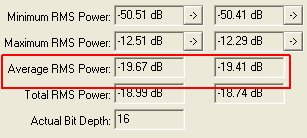
As what you can see, the track averages around -19dB and there is still a lot of headroom space remaining. So this means that if you turn the volume up, it won’t get distorted and dynamics are well preserved. In general, it gives plenty of room to adjust and provides a nice listening experience. OK, let’s examine a sample track coming from the early 90’s:
Track Title: “Come as you are”
Date released: 1992
Performed by: Nirvana
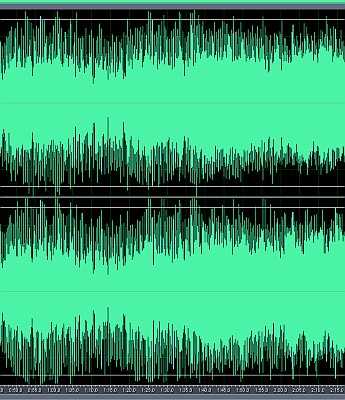

You might notice that the average volume is now louder compared in the 80’s. It averages around -16dB. Also the headroom is getting smaller so as the difference between loud and soft; nevertheless it still very nice to listen even if you turn the volume up. Next let’s examine how the loudness war progresses towards the end of the 90’s:







5 Responses
This help explains what they mean by losing dynamics.
http://www.youtube.com/watch?v=3Gmex_4hreQ
And why the problem can’t really be fixed with the volume knob.
When a drum smacks in the real world, it’s loud compared to other sounds.
We’ve lost the “kick ass impact” factor that music used to have.
And all hope of recorded music even remotely sounding like live music.
Christopher, it’s more about ear fatigue than anything else. As the progression of waveforms in the article clearly demonstrates, the dynamic range has been disappearing over the years. This leads to an all-out assault on your ears, which believe it or not are better off dealing with music that has a greater gap between loud and quiet passages.
The “loudness wars” cannot end well. Time for producers to bail out.
Well, as you can see, it seems all dynamics is lost in last Metallica example, and some of us still like the effect of dynamics in a song, without dynamics, well hello flatland. And traversing flatlands can become tiring real fast, for the ears that is. 🙂
Hi Christopher,
Nice observation. I can often complain this when I play the loud CD along with other CDs. I mean I do not listen Metallica alone in the playlist, I tend to include other tracks from other artist possibly even from the 90’s and 80’s. Some players does not have automatic volume control. So when very loud tracks are included in the playlist, I indeed turn their volume down.
Well If I am doing something else other than listening, it can interrupt your deep concentration 🙂
Dear Sir.
Okay. I know what I’m about to say must be stupid, but I don’t know why. Y’see, what I seriously don’t understand – this is not supposed to be a joke, or fictitious, or get any of the flip answers forums give me when I ask this – about the loudness war is – CD players, or MP3 players, or whatever, come equipped with a little button or slider called a volume control. If you find a Metallica track too loud, why aren’t you just using the volume control and turning it down?
On a forum, I’d be accused of being sarcastic. But I’m not. I flat don’t understand this. Why do people complain about things being too loud when they can just turn them down???
Yours extremely puzzled
Christopher Burke